


A process breaks. Sales says operations owns the handoff. Operations says the workflow changed in the CRM and nobody told them. The team lead has a checklist in a Google Doc, a manager has a newer version in Notion, and the person doing the work follows neither because the current steps changed two months ago.
That's what unclear ownership looks like in practice. Not a governance diagram. Not an org chart debate. It looks like rework, escalation, duplicate effort, and people doing their best inside a system that leaves too much open to interpretation.
The hard part is that most companies don't have a motivation problem. They have an accountability design problem. If nobody owns the process end to end, work keeps moving, but it moves with friction. That's why process ownership models matter. They decide who sets direction, who enforces standards, who participates, and how the business knows whether the process is being followed.
The High Cost of Unclear Process Ownership
When process ownership is vague, teams fill the gap with personality. The loudest manager wins. The longest-tenured employee becomes the unofficial rulebook. A project manager starts policing a workflow they do not control. None of that scales.
You can spot the pattern quickly:
- Handoffs keep slipping: Work moves between departments with missing context or changing expectations.
- Escalations go sideways: People argue about authority instead of fixing the root issue.
- Documentation drifts: The process on paper no longer matches the process in the browser, ticketing tool, or inbox.
- Metrics lose credibility: Teams debate the numbers because nobody owns the KPI definitions.
Formal ownership changes that. A Deloitte study of over 1,200 organizations found that 78% of companies with formal Global Process Ownership models achieved leading-class performance, compared to 32% of those without. The same data found that clear ownership reduced process cycle times by an average of 35% and improved KPI tracking accuracy by 42% (Deloitte GBS study summary).
That gap is big enough to treat process ownership as an operating decision, not an administrative cleanup task.
What process ownership actually means
Process ownership is the explicit assignment of accountability for how a process is designed, documented, measured, improved, and enforced across teams. It's not the same as managing one department inside the process.
A finance leader can manage AP staff without owning the full procure-to-pay process. A support manager can supervise agents without owning the full customer resolution workflow. Ownership starts where cross-functional accountability begins.
Practical rule: If a process crosses teams, systems, or regions, someone has to own the whole thing, not just one segment of it.
That's also why culture matters. Teams that want stronger execution often need to spend time building an accountable team before they redraw roles. A process owner can't succeed in a culture that rewards local optimization and individual heroics over shared outcomes.
The opportunity cost of ambiguity
Most leaders feel the pain of bad process in missed deadlines and frustrated teams. The bigger loss is hidden. Ambiguity makes improvement slower because nobody has the authority to standardize work, settle disputes, or define the source of truth.
That's where operational efficiency starts to stall. If you need a useful baseline before redesigning ownership, this breakdown of operational efficiency in practice is a good companion to the discussion. It connects process clarity to the daily mechanics of getting work done consistently.
A Comparative Guide to Process Ownership Models
No single model fits every company. The right choice depends on your scale, the complexity of your workflows, and how much variation the business can tolerate. Some process ownership models create strong consistency. Others preserve local autonomy but make governance harder.
The mistake is picking a model because it sounds mature. The better move is choosing one that your teams can operate.
Process ownership model comparison
| Model | Best For | Key Advantage | Primary Challenge |
|---|---|---|---|
| Centralized | Regulated environments, shared services, high standardization needs | Strong consistency and clearer policy enforcement | Can feel slow and distant from frontline realities |
| Decentralized or Federated | Multi-region businesses, diverse operating contexts | Better local adaptation | Standards often drift between teams |
| RACI-Based Stewardship | Organizations clarifying roles after repeated confusion | Makes accountability visible | RACI can become paperwork if authority stays fuzzy |
| End-to-End Process Owner | Cross-functional workflows with costly handoff failures | Single point of accountability across silos | Requires real executive backing to work |
| Product-Centric | Digital teams where workflows revolve around a product or service line | Aligns process decisions with customer and product outcomes | Business operations may get fragmented |
| Shared Ownership | Collaborative cultures with tightly integrated teams | Encourages broad participation | Shared accountability often becomes no accountability |
Six models and where they work
Centralized model
A central process office, transformation team, or shared services leader defines standards and often controls changes. This works well when consistency matters more than local flexibility. Financial controls, compliance-heavy workflows, and enterprise-wide support functions often benefit from this setup.
The trade-off is speed at the edge. Teams on the ground may wait too long for decisions, or they may bypass the model when central governance feels detached from operational reality.
Decentralized or federated model
Business units or regions own their own process variants under a loose common framework. This suits organizations with different customer types, geographies, or delivery constraints.
It's practical, but it invites drift. Naming conventions, approval paths, and documentation standards tend to diverge unless someone actively reconciles them.
RACI-based stewardship
This model uses explicit role mapping to separate who does the work, who owns the decision, who must be consulted, and who needs visibility. Many process ownership models use a RACI matrix to define role clarity, and the key is ensuring the Accountable role is held exclusively by the process owner so teams avoid the “shared responsibility means no responsibility” trap (RACI guidance for process ownership).
This is often the fastest way to stop confusion after a project handoff or reorganization. But it only works if the org respects the decisions attached to the chart.
A RACI matrix doesn't solve ownership by itself. It makes ambiguity visible. Leadership still has to resolve it.
Models built around the process versus the team
End-to-end process owner model
This is the cleanest answer to cross-functional chaos. One person owns the process across departments, systems, and handoffs. They don't perform every step, but they own the design, standards, outcomes, and improvement agenda.
This model is usually the strongest fit when delays happen at boundaries. The challenge is political. Functional managers may resist a process owner who can influence work without directly managing their people.
Product-centric model
Here, ownership follows the product, service line, or customer journey rather than a classic business function. Digital businesses often use this because delivery, support, and improvement cluster naturally around a product team.
It creates tight alignment with user outcomes. It can also create inconsistent back-office practices if each product area documents and governs work differently.
Shared ownership model
This appears collaborative and mature. In reality, it often works only in very disciplined teams with high trust, clear routines, and strong leaders who resolve deadlocks quickly.
Most organizations overestimate their ability to run this well. If nobody has final say, process decisions linger, exceptions multiply, and documentation becomes a collection of negotiated compromises.
A useful analogy is the difference between standard operating guidance and situational guidance. If your teams blur those, this comparison of runbooks vs. playbooks helps clarify when a process needs strict ownership and when it needs flexible response patterns.
Selecting the Right Model for Your Business
Choosing among process ownership models starts with one uncomfortable question. Where does your business suffer most from ambiguity. At the center, at the edges, or in the handoff between them?
A good model matches the way work really happens. Not the org chart. Not the slide deck. The actual flow of decisions, exceptions, approvals, and execution.
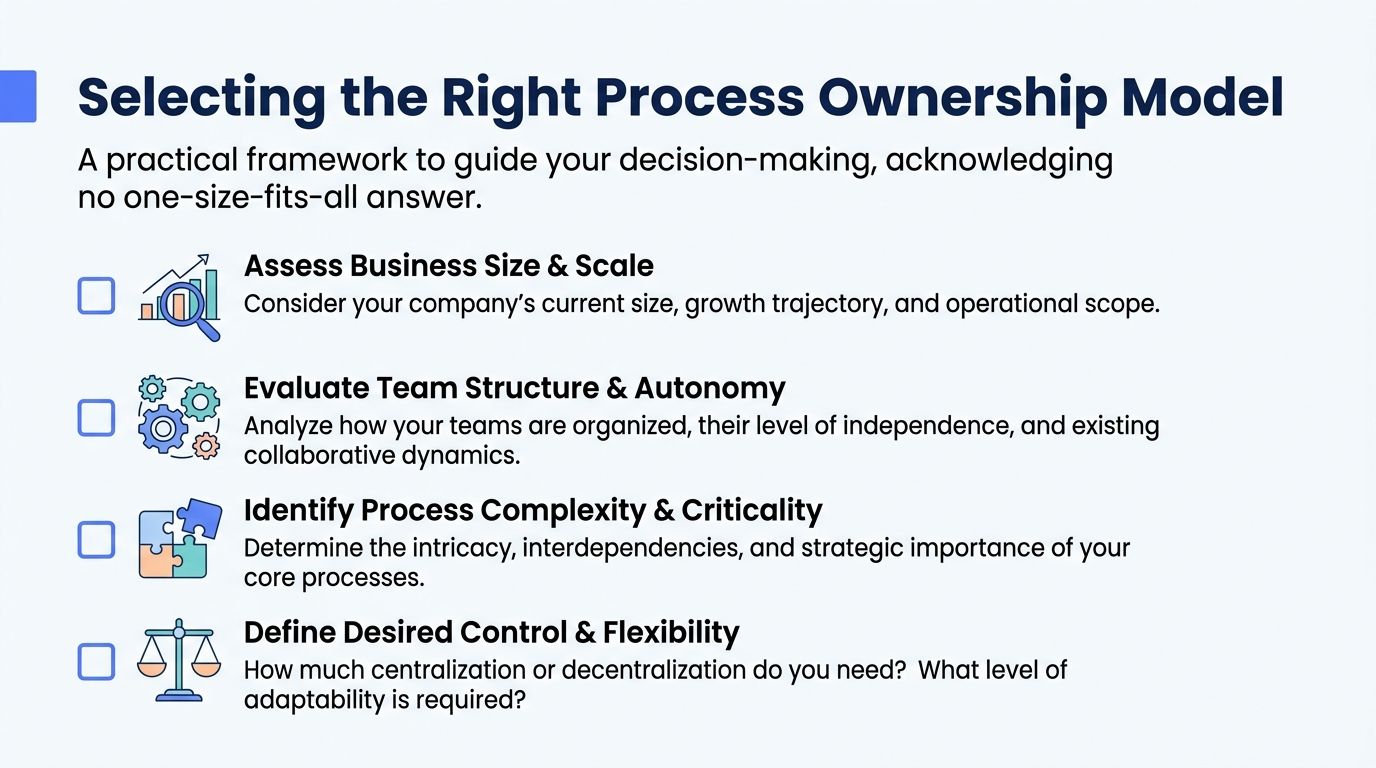
Four questions that narrow the choice
How large and complex is the operating environment?
A smaller company with a few tightly connected teams can often move faster with direct end-to-end ownership. A larger enterprise with layered approvals, regional variation, and support functions may need a centralized or federated structure to maintain coherence.How independent are your teams?
Some companies run highly autonomous business units. Others depend on shared services and common systems. If local teams make frequent context-specific decisions, a federated model may fit better. If variation causes costly mistakes, central ownership usually wins.How critical is the process?
A low-risk internal workflow can tolerate looser governance. A process tied to customer commitments, financial control, compliance, or service quality usually needs explicit accountability and tighter review.How much control versus flexibility do you need?
That trade-off drives most ownership design. More control gives cleaner standards and easier reporting. More flexibility helps teams adapt to local realities.
A practical matching guide
Use this quick lens when deciding:
- Choose centralized when the cost of inconsistency is higher than the cost of slower change.
- Choose federated when local variation is real and unavoidable, but you still need a common framework.
- Choose end-to-end ownership when handoffs are the main source of delay, conflict, or rework.
- Choose RACI-based stewardship when roles are muddy and people keep stepping on each other's authority.
- Choose product-centric when the product or service experience is the natural organizing unit.
- Be careful with shared ownership unless you already have strong decision discipline.
The best model is the one your managers can explain in one meeting and your frontline teams can follow the next day.
Watch for the hidden constraint
Most companies think they're choosing a governance model. They're also choosing a documentation burden. The more distributed the business is, the more your ownership model depends on current, accessible instructions that people can trust. If the documentation system is weak, even a good model will look like a bad one.
A 4-Step Framework for Implementation
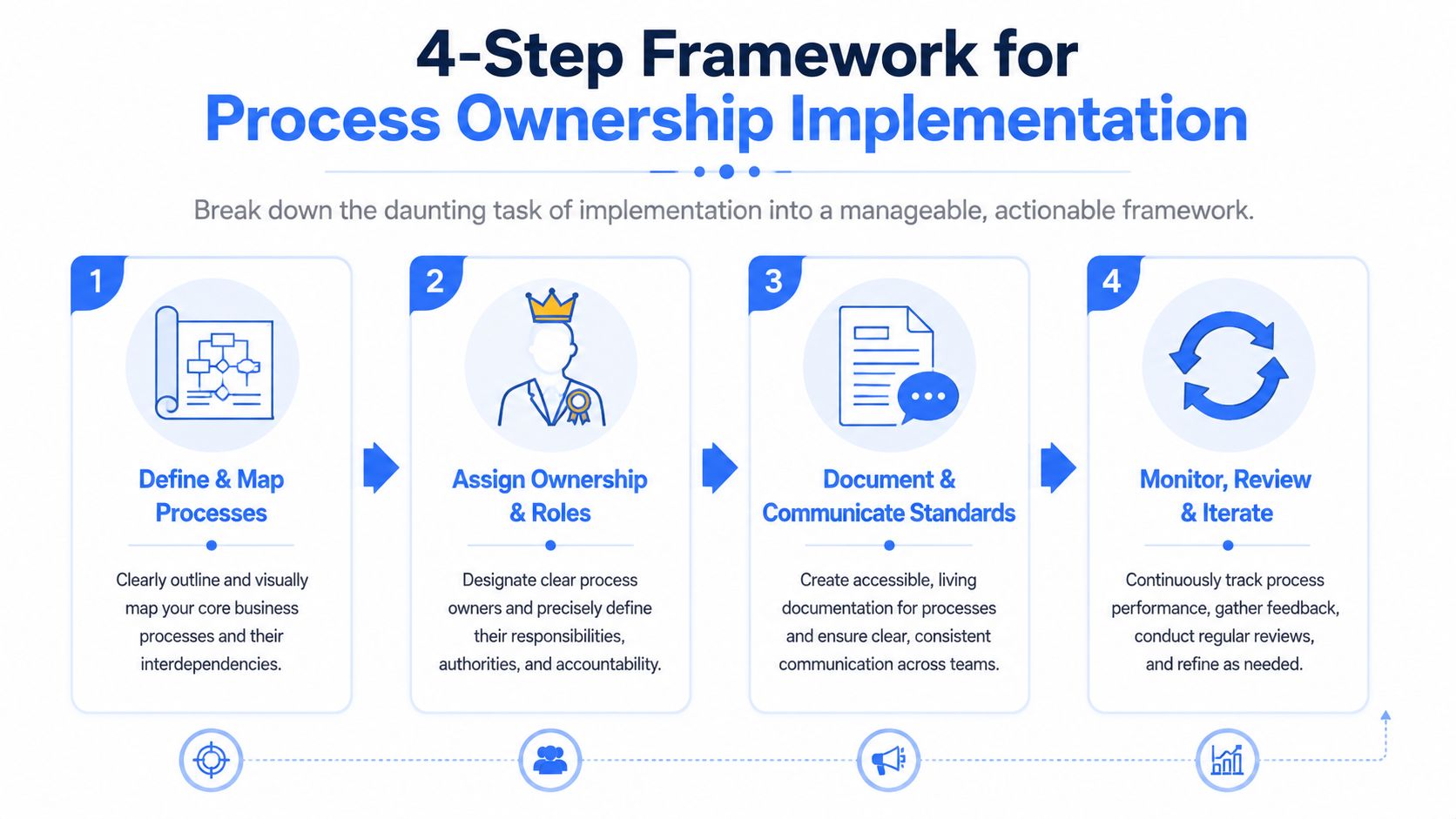
Most ownership failures happen after the org chart decision. Leaders announce the model, assign names, and assume the structure will create behavior. It won't. Implementation needs visible process mapping, explicit authority, usable documentation, and review habits.
Step 1 and Step 2
1. Define and map the process
Start with one critical workflow, not the whole enterprise. Map the trigger, major stages, handoffs, approvals, systems used, exception paths, and completion criteria.
If your teams need a better method for that work, these process mapping best practices are useful because they focus on making workflows readable and operational, not decorative.
2. Assign ownership with formal authority
For complex cross-functional work, effective implementation often uses a 3-tier delegation of authority with Process Leaders setting direction, Process Owners holding accountability, and Process Stewards executing the process (BPM Institute paradigm shift article).
Write a charter for each key role. It should state decision rights, escalation paths, KPI responsibilities, change approval authority, and where functional managers still retain control.
Step 3 and Step 4
Before moving into documentation, it helps to see how teams use AI tools productively in structured environments. This guide to Claude for enterprise productivity is helpful because it shows how AI becomes useful only when workflows and expectations are already clear.
3. Document and communicate the standards
People can't follow what they can't find. Publish the current workflow, decision rules, and definitions of done in a format teams will find practical. That usually means lightweight, visual, searchable documentation instead of static binders and long policy files.
Then train to the actual process. Not the ideal one. If the actual workflow includes workarounds, surface them and decide whether to standardize or eliminate them.
A short walkthrough often helps more than a long launch memo.
4. Establish the first governance rhythm
Start simple. Monthly review works better than building a giant committee structure no one attends. Review process health, policy exceptions, unresolved bottlenecks, and upcoming changes that could affect the workflow.
Operator's note: Governance works when meetings produce decisions, owners, and deadlines. If review sessions become commentary forums, the model is already weakening.
Measuring Success with Governance and KPIs
A process ownership model only becomes real when the owner has authority over decisions that affect outcomes. If the role is limited to maintaining diagrams, governance turns ceremonial fast.
Effective models give Process Owners real “teeth,” including joint decision-making authority on process design and the power to determine KPIs, so the role has influence on outcomes rather than just administrative responsibility (process ownership technical framework).
What governance has to include
Governance doesn't need to be heavy, but it does need to be explicit. At minimum, effective oversight includes:
- Decision rights: Who can approve process changes, exceptions, and standards.
- KPI ownership: Who defines the measures and who verifies the data.
- Review cadence: When process performance, deviations, and open issues are examined.
- Escalation logic: What happens when a functional manager and process owner disagree.
- Change communication: How updates reach the people doing the work.
Without those mechanics, ownership lives in a slide deck and dies in daily operations.
Measure outcomes, not heroics
The wrong KPI design undermines ownership fast. If individual employees get rewarded for speeding through their part while the full process suffers, the system pushes people away from end-to-end performance.
Strong governance tracks process outcomes such as completion quality, handoff readiness, adherence to standards, and exception patterns. The exact metrics should reflect the process, but the principle is stable. Measure what the process is supposed to achieve across the chain, not who looked busiest inside one segment.
That's also where many implementations get political. Functional leaders often want KPIs they can directly control. Process owners need KPIs that reflect cross-functional performance. Those aren't always the same, and leaders need to settle the conflict openly.
Give the role enough power to work
A process owner needs enough standing to coordinate stakeholder conversations, chair process reviews, and push changes through the organization. If they can spot issues but can't influence process design, standards, or KPI definitions, they're a librarian, not an owner.
Good governance doesn't create more meetings. It creates fewer unresolved arguments.
The healthiest setups make accountability visible in performance reviews, process reviews, and change decisions. That's what gives the model durability.
Closing the Ownership Gap with AI-Powered Documentation
Traditional process ownership models assume leaders can observe enough of the workflow to govern it. That assumption breaks in distributed teams. Remote operations, outsourced support, field workflows, and multi-region service delivery all create the same problem. The designed process and the executed process drift apart, and nobody notices quickly enough.
A critical gap in existing models is their failure to adapt to hybrid, non-linear teams where a single owner can't physically observe workflows. Models built around static architecture struggle to assign accountability in decentralized environments, and automated, click-verified documentation helps solve that problem (KPMG discussion of end-to-end process management challenges).
Where old models break down
The classic model says the process owner documents the workflow, publishes standards, and monitors adherence. That sounds clean. In practice, teams change tools, browser flows, approval patterns, and handoff behaviors constantly.
A static SOP is outdated faster than most governance teams admit. That doesn't make ownership irrelevant. It makes documentation and verification central to ownership.
For teams dealing with modern content operations and constantly changing workflows, this guide to process documentation for content creators is a good example of how documentation needs to be practical, repeatable, and easy to update.
The technology layer modern ownership needs
Modern tooling is crucial. Process owners need a system that captures what people do, keeps instructions current, and makes standards easy to share across time zones and functions.
That's why AI-powered SOP enhancers are increasingly relevant. They reduce the manual burden of turning real work into usable process documentation. AI-powered Knowledge Base generators matter for the same reason. They turn scattered guides, partial instructions, and tribal knowledge into a searchable source of truth that governance can rely on.
If you want to see the kind of operational content structure that supports this, browse a few examples of practical how-to guides for teams. The pattern is simple. The easier documentation is to create and maintain, the more likely process ownership models are to survive contact with real operations.
The key shift is this. Ownership can't rely only on hierarchy anymore. It needs visibility into execution.
Avoiding Common Pitfalls and Taking Action
Most failed process ownership models collapse for ordinary reasons. The owner has responsibility without authority. The roles are defined once and never reinforced. Documentation goes stale. Governance turns into reporting without decisions.
Avoid the common traps:
- Don't assign ownership without decision rights.
- Don't confuse functional management with end-to-end accountability.
- Don't launch a model before the process is documented in a usable form.
- Don't let review meetings become passive status updates.
- Don't treat distributed teams as if observation happens automatically.
Start smaller than you think. Pick one important cross-functional process. Name the owner. Clarify the handoffs. Define the KPI logic. Create documentation people can effectively use. Then run the model long enough to learn where authority, standards, and visibility still break down.
That's how process ownership becomes operational instead of theoretical.
If you're ready to turn process ownership into something teams can follow, StepCapture gives you a practical way to do it. Its browser-based recorder turns real workflows into step-by-step SOPs, its AI-powered SOP enhancers reduce the writing burden, and its AI-powered Knowledge Base generator helps consolidate documentation into a searchable source of truth. That combination makes it easier to support process owners with current documentation, faster onboarding, and clearer governance across distributed teams.


