


A lot of plants are still running on memory, habit, and whoever happens to be on shift. One operator knows the workaround on Line 3. One tech remembers the startup sequence on the older filler. A supervisor can spot a bad setup by sound alone, but the new hire can't. Then that expert takes a vacation, moves shifts, or leaves, and the floor starts paying for undocumented knowledge through scrap, slow training, missed checks, and preventable safety risk.
That's usually the moment leaders start looking seriously at an SOP for manufacturing. Not because they suddenly love paperwork, but because inconsistency gets expensive fast. The true job of an SOP isn't to fill a binder. It's to make the correct method visible, repeatable, and usable under real production pressure.
From Workshop Chaos to Clockwork Precision
A common scene on the floor looks like this. A new operator is trained by a capable veteran, but the handoff is rushed because the line is behind. The veteran says, “You'll get used to it,” points to a few controls, and adds two unwritten checks that “everyone knows.” On second shift, another operator runs the same job a little differently. Quality drifts. Setup takes longer than it should. When a defect shows up, the team argues about which method is standard.
That isn't a people problem. It's a system problem.
A practical SOP for manufacturing fixes that by turning tribal knowledge into standard work. It gives operators one approved method, gives supervisors a baseline for coaching, and gives quality and safety teams a document they can verify against actual practice. Done right, it doesn't slow the floor down. It removes hesitation, rework, and variation.
The payoff is tangible. Plants with mature SOP programs reported 20 to 25% higher productivity and 30 to 40% reductions in training time for new operators, and companies that systematized SOPs saw median error rates fall from about 2.8% to 1.2% of orders over a 3-year period according to Echo360's manufacturing SOP article.
Practical rule: If two trained operators can perform the same task in two different ways, you don't have a stable process yet.
The old idea of an SOP as a dense Word document in a supervisor's office doesn't work well on a noisy production floor. Operators need visual steps, clear checkpoints, and instructions they can scan in seconds. They also need documents that reflect today's machine settings, today's material flow, and today's quality risks.
That's why SOPs work best when they're treated as operating tools, not audit decorations. A strong procedure shortens ramp-up time, reduces avoidable mistakes, and gives the whole team a common language for improvement. If your broader goal is smoother throughput, less firefighting, and fewer handoff mistakes, this guide on improving operational efficiency in manufacturing fits the same discipline.
The Foundation of a Strong Manufacturing SOP
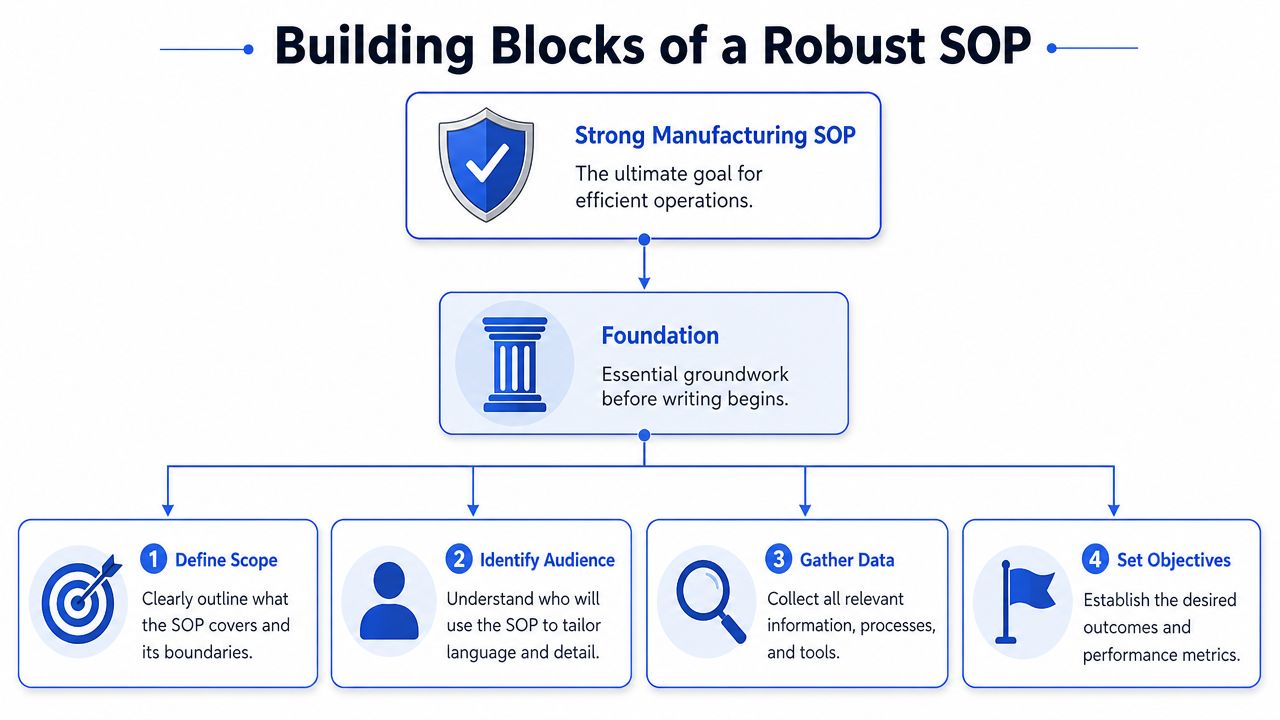
Most weak SOPs fail before the first sentence is written. The team starts documenting a process that's too broad, too vague, or not important enough to justify the effort. Good SOP programs start with prioritization, ownership, and traceability.
Start with the right process
Not every task deserves the same level of documentation. Best-practice frameworks recommend prioritizing SOP creation for operations posing worker-safety risks, requiring technical expertise, or prone to quality variation, especially where compliance requirements or high error rates are involved, as reflected in this structured work procedure example.
A simple way to choose your first SOPs is to ask four questions:
- Could this task hurt someone if done wrong? If yes, document it early.
- Does this step affect product quality directly? Inspection points, setups, calibrations, and changeovers usually do.
- Is this hard to teach consistently? Technical tasks with lots of “small but important” details belong near the top of the list.
- Does this process change hands often? High-turnover or multi-shift tasks need standardization fast.
Build the document like a controlled process
An SOP for manufacturing should read like an operational control document, not a training memo. At minimum, include the following:
| Element | Why it matters |
|---|---|
| Clear title | Helps operators and auditors identify the exact process quickly |
| Unique SOP ID | Supports traceability and avoids confusion between similar procedures |
| Effective date | Shows when the current version became valid |
| Version number | Prevents old copies from circulating unnoticed |
| Purpose statement | Explains why the procedure exists |
| Scope | Defines where the SOP starts, stops, and applies |
| Roles and responsibilities | Makes ownership explicit |
| Procedure steps | States the approved method in usable sequence |
That structure keeps documents disciplined. It also prevents the common mess of three nearly identical instructions floating around with no clear owner.
Scope beats length
A strong SOP is specific. “Operate press brake safely” is too broad. “Set up Press Brake 2 for Part Family B after tool change” is usable. The tighter the scope, the easier it is to test, train, revise, and enforce.
A document becomes useful when it answers one question cleanly: what exactly is the correct way to do this task in this plant, on this equipment, under these conditions?
If your team is still inconsistent about format, naming, approval flow, or document ownership, it helps to standardize your method before you standardize the work. These process documentation best practices are useful for setting that baseline.
How to Write SOPs That People Actually Use
Plenty of SOPs are technically complete and still fail on the floor. They're too wordy, too abstract, or written by someone who understands the process but not the operator's reality. Good writing for manufacturing is plain, direct, visual, and tied to the point of use.
Near the start of drafting, it helps to see what modern documentation workflows look like in practice.
Write for the floor, not the conference room
Operators don't need elegant prose. They need instructions they can follow while wearing gloves, under time pressure, with a machine waiting. That changes how you write.
Use short, active steps. Put one action in one line where possible. Replace vague verbs with observable actions.
Compare the difference:
- Weak instruction: Tighten bolts properly.
- Better instruction: Tighten bolts in the specified sequence and verify the setpoint on the torque tool before release.
- Weak instruction: Check material.
- Better instruction: Confirm material label matches the scheduled job before loading.
The goal is clarity, not literary polish.
Use the what, how, and why structure
One of the most effective changes you can make is to write each major step with three parts:
- What to do
- How to do it
- Why it matters
That third part gets skipped too often. It shouldn't. A 2019 industry survey found that SOPs explicitly incorporating “why” statements had 26% higher first-time-right performance and 18% shorter training cycles, and having a novice operator test the draft SOP can uncover 30 to 50% of ambiguous or missing steps, according to MRPeasy's manufacturing SOP guidance.
Here's what that looks like in practice:
- What: Verify the fixture is seated flush.
- How: Inspect all contact points before clamping and remove visible debris.
- Why: Mis-seating changes part position and can create repeat defects that look like tool drift.
That small addition reduces blind compliance. Operators are far more likely to follow a step consistently when they understand what failure it prevents.
On the floor, “why” turns a rule into judgment. That matters when conditions aren't perfect.
Visuals do the heavy lifting
For physical work, images often carry more value than paragraphs. A photo with an arrow to the right valve, a close-up of the correct part orientation, or a quick clip of a setup sequence can prevent mistakes that text alone won't catch.
Manufacturing guidance also expects procedures to visually support the text through images, annotations, and sometimes video, with pictures acting as the foundation of the instruction flow, as described in this ready-mixed concrete facility SOP resource.pdf).
A useful rule is simple:
- Use photos for equipment locations, hand positions, part orientation, and examples of acceptable condition.
- Use diagrams when flow, sequence, or branching decisions matter.
- Use short video for tasks with motion that a still image can't explain well.
This walkthrough gives a helpful example of how teams can learn how to build SOPs in a way that balances written steps and usable structure.
Later in the drafting process, a short demo can help teams align on how recorded workflows become clear procedures.
Make drafting easier than avoiding it
One reason SOP programs stall is that writing takes too long. Capturing screenshots, naming files, drafting steps, cleaning up wording, and formatting the final document can eat hours for a single task.
Tools can remove a lot of that friction. For example, StepCapture records workflows and turns them into step-by-step guides. Its AI-powered SOP enhancers can help generate clearer contextual descriptions from captured actions, which is useful when a supervisor or engineer wants to review and refine a first draft instead of writing every line from scratch. If your team documents digital setup screens, QA systems, machine interfaces, or internal workflows alongside floor procedures, that approach can save a lot of manual effort. This practical guide on the procedure for writing procedures also helps tighten the drafting process.
Integrating Safety and Quality Compliance
A manufacturing SOP isn't complete if safety and quality are parked in separate binders. Operators need those controls inside the procedure, at the exact moment the risk appears. If the warning sits in a preamble and the checkpoint sits in an appendix, both will be missed when production speeds up.
Put controls where the action happens
The safest and most reliable SOPs embed requirements directly into the step sequence.
For example, don't write a general note saying PPE is required somewhere near the top of the page. Put the requirement at the task where exposure begins. Don't write “inspect part for defects” at the end. Put the quality check immediately after the operation that can introduce the defect.
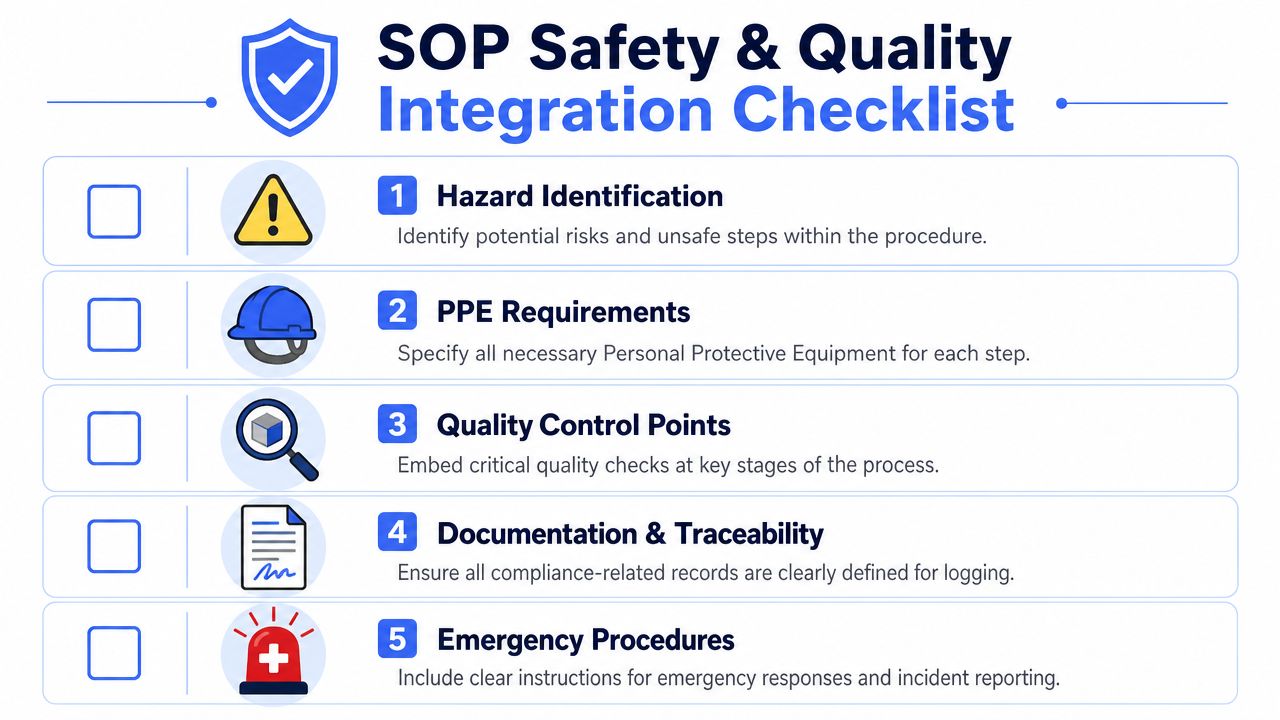
A practical layout might look like this:
- Step instruction: Load fixture and clamp part.
- Safety callout: Wear cut-resistant gloves before handling sharp-edged blanks.
- Quality checkpoint: Confirm part is fully seated against the rear stop before cycle start.
- Record requirement: Log first-piece verification in the quality form.
That format keeps the operator's eye on the task and the control together.
Replace vague language with pass or fail criteria
Quality problems love vague instructions. “Check alignment.” “Confirm correct fill.” “Tighten properly.” None of those statements tell the operator what success looks like.
Use objective wording instead:
| Vague wording | Usable wording |
|---|---|
| Tighten properly | Verify tool is set to the approved value before release |
| Check label | Confirm label matches current job and is legible before pack-out |
| Inspect part | Verify critical features against the defined acceptance point |
| Use PPE | Wear listed PPE before opening the guard or handling the material |
The same rule applies to safety. If there's a lockout step, guarding requirement, sanitation requirement, or line clearance check, write the expected action and verification plainly.
Keep the SOP practical and audit-ready
You don't need to stuff every external standard into the body of the procedure. That usually makes the document harder to use. Instead, reference the related standard, policy, or form where needed and keep the operator-facing step focused on action.
Field-tested advice: Operators need the instruction. Auditors need the traceability. A good SOP gives both without making the operator read like an auditor.
If you're working in a regulated environment, keep the procedure linked to the relevant forms, control plans, and training records. That way the SOP stays clean, but the evidence trail stays intact. The document should help someone do the work correctly first. Compliance becomes stronger when the procedure matches real practice.
Rollout and Training for Seamless Adoption
The fastest way to kill an SOP program is to announce it like an administrative project. People on the floor won't embrace a new procedure because leadership says documentation matters. They'll adopt it when the SOP helps them avoid mistakes, reduce friction, and get through the shift with less rework and less guessing.
Roll out with a pilot, not a memo
Start with one process, one area, and one representative group. A pilot exposes the friction that conference room reviews never catch. The wording might be clear on paper but awkward at the machine. A photo might show the wrong angle. A sign-off step might make sense to quality but slow the operator for no value.
That's why small-scale rollout works better. Test the SOP with the people who will use it. Then revise before full launch.
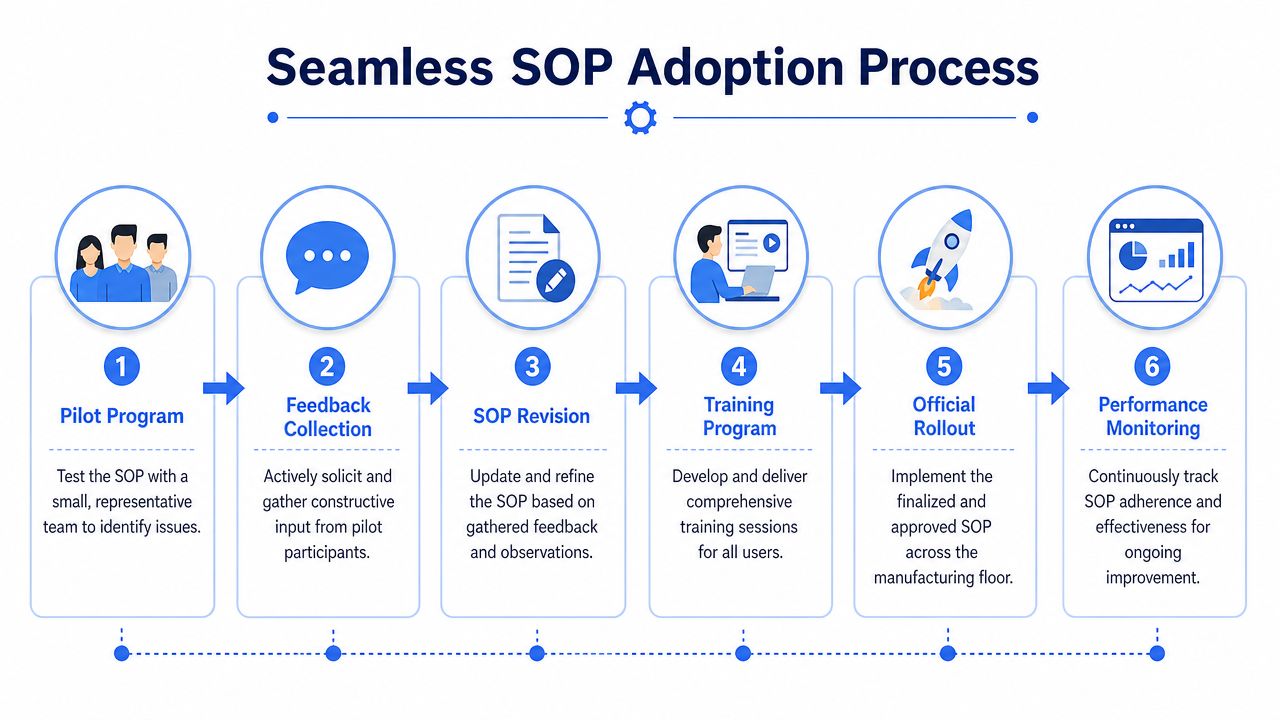
A simple rollout sequence works well:
- Pilot with a small team on a live process.
- Watch the task being performed using the SOP.
- Collect operator feedback right after use.
- Refine wording, visuals, and checkpoints based on real friction.
- Train supervisors first so coaching is consistent.
- Launch broadly only after the process feels usable
Explain why the change helps operators
Resistance usually isn't about the idea of standard work. It's about what people think is coming with it. If operators hear “new SOP rollout,” many assume more paperwork, more blame, or less trust.
Leaders need to frame it differently and transparently.
- Safer work: The procedure makes hazards easier to see and less dependent on memory.
- Easier training: New people get one clear method instead of three opinions.
- Less rework: Quality checks happen at the right point, not after the damage is done.
- Fairer accountability: The standard is documented, so coaching is based on the agreed method.
If the team believes the SOP was written to catch them out, they'll work around it. If they see it was written to help them succeed, they'll help improve it.
Train through demonstration and verification
Manufacturing training still works best when people can see the task, perform it, and get immediate correction. Reading alone isn't enough. A practical training approach usually combines supervisor demonstration, guided repetition, peer support, and direct observation.
Supervisors should verify that the operator can perform the task to standard, not just say they've read the SOP. That's the point where the document becomes real. If your team needs a more structured path for instructor-led and on-the-job learning, this guide on how to develop a training program is a useful companion.
SOP Maintenance and Continuous Improvement
Most companies know how to launch SOPs. Far fewer know how to keep them alive. That's where long-term value is won or lost.
Processes change. A machine is moved six feet. A fixture gets redesigned. A supplier changes packaging. A quality check is added after a customer complaint. If the SOP doesn't move with the process, it starts giving bad instructions while everyone assumes it's current. That's dangerous.
Research highlighted in this discussion of SOP maintenance gaps notes that outdated work instructions are a frequent root cause of nonconformities and that manufacturers often under-address how to maintain SOPs as processes evolve. That gap between the static document and the changing shop floor is where many SOP programs decay.
Build triggers, not just calendars
A yearly review is useful, but it isn't enough on its own. Strong maintenance systems use both scheduled reviews and event-driven triggers.
Use a formal review when the document reaches its planned cycle. Trigger an immediate review when any of these happen:
- Equipment changes: New controls, tooling, guards, or layouts
- Process changes: Different sequence, different material flow, different setup method
- Quality events: Repeated defects, escapes, or revised control points
- Safety events: Incidents, near misses, or hazard reassessments
- Operator feedback: Repeated confusion, workarounds, or missing steps
That approach keeps the SOP tied to reality instead of admin timing.
Version control has to be visible
Operators should never have to guess which version is current. Every SOP needs an owner, revision date, and version identifier that's easy to spot. Outdated printed copies should be removed quickly, not left clipped to machines “just in case.”
A practical system includes:
| Control | What it prevents |
|---|---|
| Named document owner | Unclear responsibility for updates |
| Visible revision history | Hidden changes and audit confusion |
| Archived prior versions | Loss of traceability |
| Single access point for current SOPs | Parallel versions in circulation |
Centralize knowledge so people can find it
In this context, digital tools earn their keep. A searchable system is far better than scattered PDFs, printed binders, and supervisor desktops. Teams need one place to find the current procedure, related forms, and supporting visuals.
An AI-powered Knowledge Base generator can help by organizing SOPs into a single searchable reference so operators, trainers, and supervisors can find the latest approved version without hunting through folders or relying on an old printout. That matters just as much for maintenance, quality, and internal support processes as it does for machine operation. When the current method is easy to find, people are more likely to follow it. When it's hard to find, they'll default back to memory.
Your Path to Standardized Excellence
A strong SOP for manufacturing doesn't start with templates. It starts with a decision to stop letting critical work depend on memory, heroics, and shift-to-shift variation. The document matters, but the bigger win comes from the lifecycle around it. Choosing the right processes, writing in clear language, embedding safety and quality into each step, rolling out with operator buy-in, and maintaining the procedure as the process changes.
That's how SOPs become operational tools instead of shelfware.
Start small. Pick one process that causes pain now. A setup that takes too long. A task that trains poorly. A recurring defect. A safety-sensitive activity that still depends too much on verbal coaching. Build one procedure properly, test it, train it, and improve it from real use.
If your next step is broader operational standardization across scheduling, inventory, and production control, it also helps to streamline factory management with ERP so the documented process and the system workflow support each other.
A disciplined SOP system doesn't make your plant rigid. It makes performance repeatable. That's what gives teams the confidence to improve.
If you want a simpler way to capture procedures, turn workflows into shareable guides, and keep SOP knowledge organized in one place, take a look at StepCapture. It's a practical option for teams that need faster documentation, clearer training materials, and a searchable knowledge base without building everything manually.


